
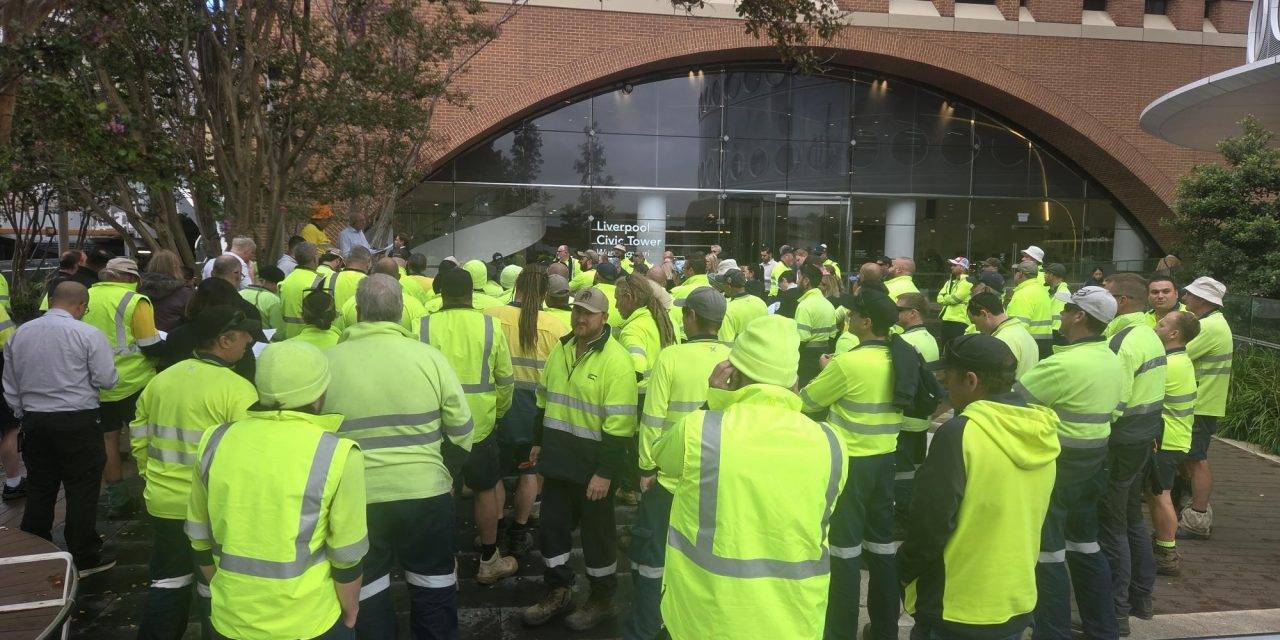
USU members at Liverpool City Council have sent a clear message: union delegates must be able to represent their members without fear of being singled out for doing their job.
A recent dispute involving one of our Liverpool City Council delegates demonstrates exactly why strong workplace representation, backed by a strong Union, matters.
The dispute began after our delegate exercised her workplace rights by initiating a grievance. Following that process, she was issued with a First and Final Warning.
The matter did not end there.
A short time later, Liverpool City Council proposed significant organisational changes that could have resulted in approximately 150 jobs being cut across Council.
USU members responded collectively.
Member meetings were held across Council workplaces, giving members an opportunity to have their say about the proposed changes and determine how they wanted their Union to respond.
Those meetings resulted in an extraordinary 47 motions being moved by members.
These were not the decisions of one delegate. They were decisions made collectively by Union members.
Our delegates, alongside members across Council, acted in accordance with the motions that had been democratically considered and supported.
Despite this, the Union’s position was that one delegate was subsequently singled out by management and issued with a Show Cause process.
Delegates are elected or chosen by their fellow workers to be their voice in the workplace.
They raise grievances. They question decisions. They represent members. They communicate Union positions. And when members collectively determine a course of action, delegates have an important role in representing those decisions.
No delegate should be placed in a position where they fear disciplinary action simply because they have stood alongside their fellow members and carried out their representative responsibilities.
The USU was therefore not prepared to stand by while one of our delegates faced the prospect of losing her employment.
USU Organiser Zoran Ristevski and Metro Manager Steve Donley entered into extensive discussions with Liverpool City Council’s Chief Executive Officer in an attempt to resolve the dispute.
Following those discussions, the Union understood that an agreement had been reached with the CEO that the Show Cause process would be withdrawn.
However, Council subsequently proceeded with the disciplinary process and moved towards terminating the delegate’s employment.
That was a line the Union was not prepared to allow to pass unchallenged.
The Union immediately took up the delegate’s case and commenced proceedings in the NSW Industrial Relations Commission, preventing the proposed termination from simply proceeding unchallenged.
The matter ultimately came before the Commission for conciliation.
Following that process, an agreement was reached which saw the Show Cause replaced with a Letter of Expectation.
For our delegate, this meant the threat of termination was removed.
But the outcome achieved something broader for USU members at Liverpool City Council.
As part of the resolution, Council gave an undertaking that a set of agreed Key Performance Indicators (KPIs) would be established for the Development Application section to provide an identified trigger for a performance discussion before disciplinary action is taken against members in relation to those performance expectations.
That outcome provides greater transparency and gives workers a clearer understanding of what is expected of them before matters escalate into disciplinary proceedings.
This dispute is an important reminder of why Union delegates matter.
Being a delegate is not always easy.
Delegates are often the people who have to ask the difficult questions, challenge decisions, raise grievances and stand beside members when they need representation most.
They should never stand alone when they do so.
When management action threatens a delegate’s employment, the Union will examine the circumstances, defend our members’ workplace rights and use the industrial avenues available to us when necessary.
In this case, the USU acted, from workplace discussions with senior management through to proceedings before the Industrial Relations Commission.
The result was that our delegate kept her job, the Show Cause was replaced with a Letter of Expectation, and an important undertaking regarding performance expectations was secured for members.
But perhaps the most important message is a simple one:
When members stand together, delegates represent them and the Union stands behind its delegates, no worker has to face management alone.
An attack on a delegate for legitimately representing members is an attack on effective union representation, and the USU will always defend the right of our delegates to stand up for their members.

